Katexac Gallery
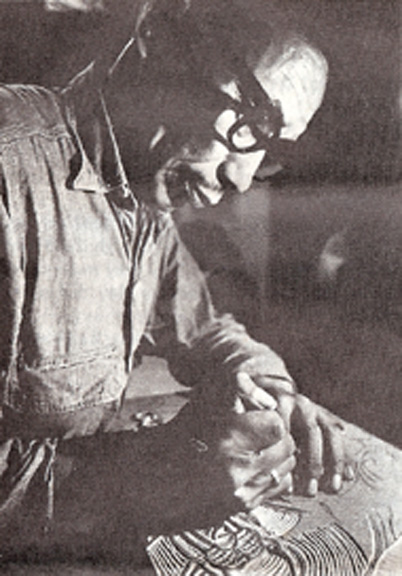
Bernard Tuglamena Katexac
King Island & Nome, Alaska
1922-1997
Bernard was born on King Island, a small point of rock off the Seward Peninsula in 1922. He was the oldest of seven children. He grew up in the traditional King Island Eskimo life, hunting seal and walrus in winter and traveling to Nome by skin boat each summer to live on the beach, fish, and carve ivory. The King Islanders have settled in a permanent village at the edge of nome, returning to their ancestral home only for spring hunt
Bernard attended the Bureau of Indian Affairs grade school on King Island and completed the eighth grade. He never went to high school. By the time he was 14, he had learned to carve ivory, partly by watching older carvers and partly through an elementary school carving program.
He moved to Nome in 1966. Shortly after his arrival, Bernard saw an article in the Nome Nugget describing a class in block printing. Bernard took the course. On the basis of this early work, the BIA awarded him a one-year BIA scholarship in art. At the university, Bernard explored a variety of art media and later branched out to courses in social science and other areas. Dr. Charles Keim encouraged him to work for a degree and in 1970 Bernard graduated as a Vocational Associate of the Arts.
Bernard lived in Nome with several other family members of family. He never married. Hunting and fishing was an important part of his life and he usually went out in the boats on the big spring hunt with other King Island men. Although Bernard preferred to do etchings, the equipment was not available in Nome. Instead, he has become well-known in the area for his colorful woodblock prints of arctic animals and eskimo life.
From the Sweeney collection
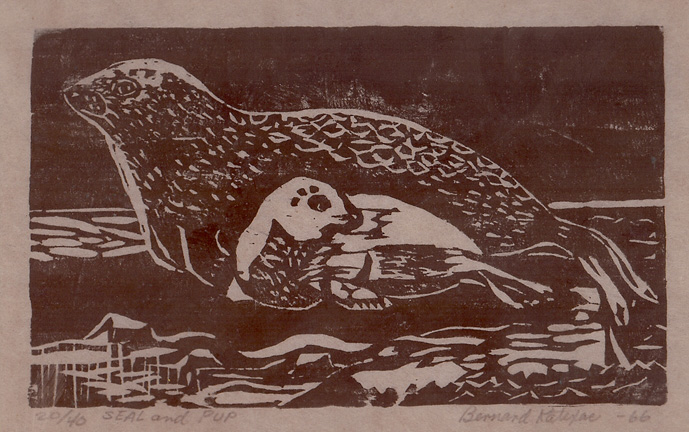
Katexac print titled “Seal and pup” – 66, meaning 1966
From the Sweeney collection
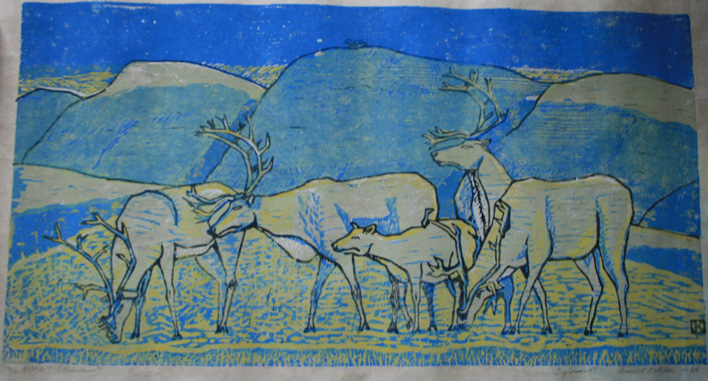
Katexac print titled “kongit” (reindeer) (qaglamina) (sp) 64, meaning 1964
From the Sweeney collection
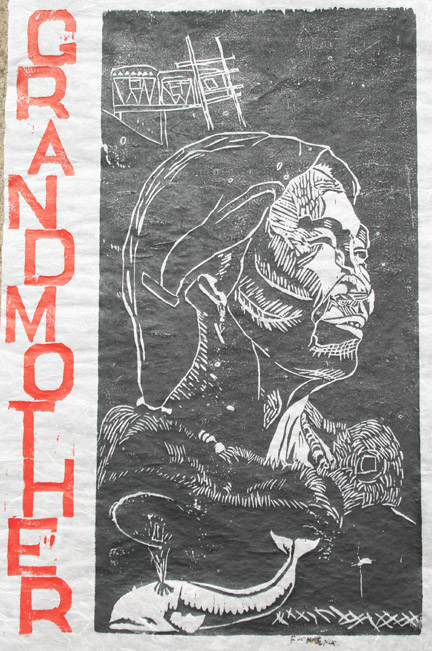
Katexac print titled “Grandmother”
From the Paul Harris collection


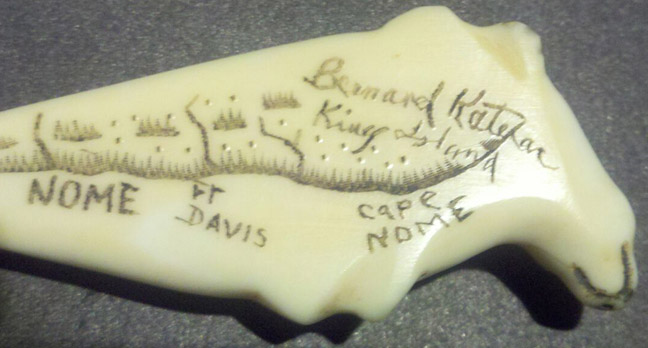
Katexac ivory letter opener map highlighting King Island, Cape Douglas, Cape Wooley, Cape Rodney, Sledge Island, Nome, Fort Davis, Cape Nome
From the Sweeney collection
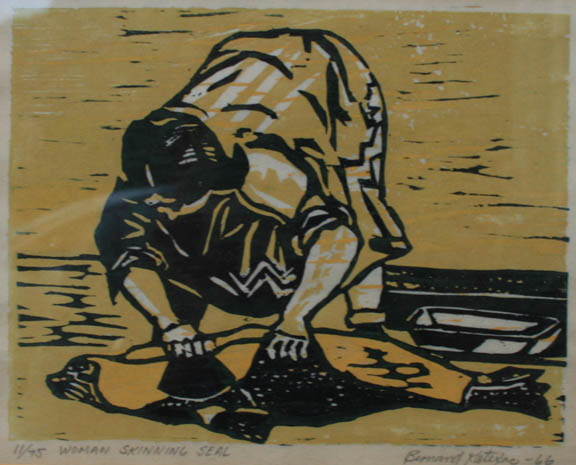
Katexac print titled “Woman skinning seal” #11/75, 66, meaning 1966
From the Sweeney collection
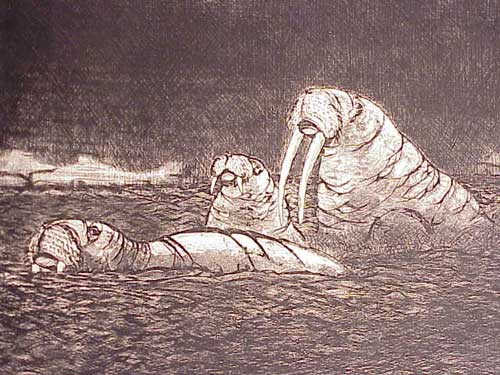
Katexac print titled “puiet” sea travelers – artist proof, 65, meaning 1965
From the Sweeney collection
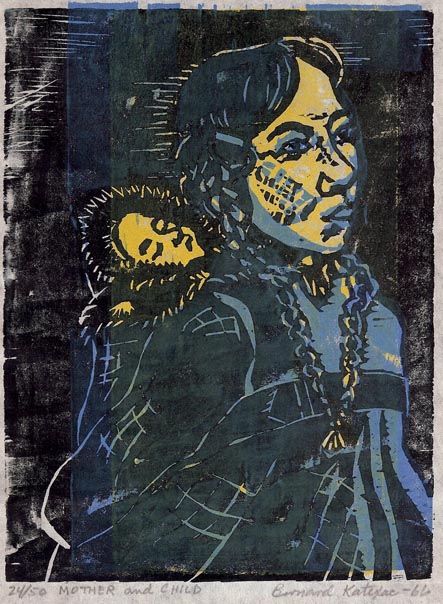
Katexac print titled “Mother and child”, print # 24/60, 66, meaning 1966
from the Sweeney collection
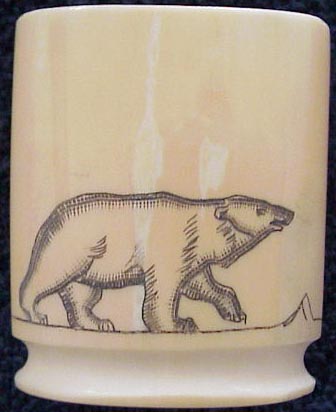
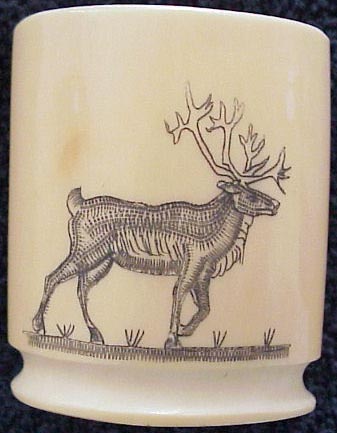
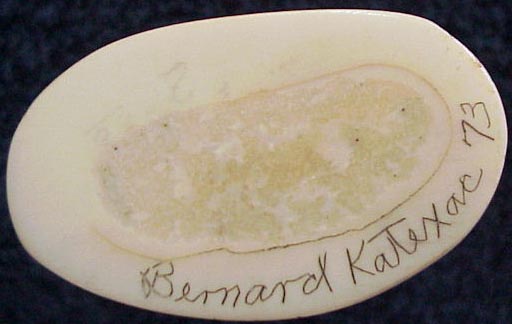
signed Bernard Katexac on bottom of ivory scrimshaw cup with a polar bear and reindeer, 73, meaning 1973
From the Bob and Nettie Nelson collection
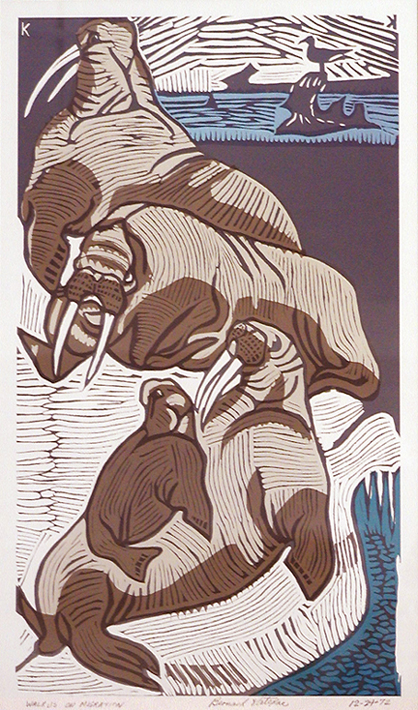
Katexac print titled “Walrus on migration”, of 800 lithographs
Nome was battered by a severe storm in 1972, which came in off the Bering Sea with waves that crashed over the sea wall and sent walls of water cascading down front street. Damage to everything on the ocean side of the street was extensive. The town library, which was in the basement of one of the buildings on the southern end of town, was flooded. The run of 800 lithographed prints of this woodcut was authorized as a fundraiser for the library. – Bob & Nettie Nelson
Walrus on Migration
A reproduction from original wood blocks by Bernard Katexac
The walrus is one of the largest and most important mammals living in alaskan waters. A large male may weigh one and a half tons. Walrus live at the edge of the polar ice pack. They stick to shallow water where they can easily dive to the bottom to feed on fish, shellfish and other creatures of the seabed. Each fall they move south through the bering straits in family groups ahead of the polar pack ice and in april or may they move north again following leads (openings) in the sea ice. They young are born in may during the northward migration. They remain with their mothers until their tusks grow long enough to dig up food, about two years. Walrus are sociable animals with a strong community spirit. They will go to the aid of a wounded fellow rather than flee to safety.
The eskimos of alaska’s western bering sea coast have long depended on the walrus for a major part of their livelihood. Nothing is wasted. The meat provides food; The hid is used for boat coverings, for rope and for the (fur boots) soles. Rain parkas are made from the intestines; Food storage bags and drum heads come from the stomach, thread from the sinews. The bones are fashioned into tools and weapons and ivory tusks provide the traditional Eskimo art mediums.
Bernard has chosen to show a walrus family resting on an ice flow during one of the migration periods. The print is made with the understanding and respect of a man who knows his own well-being is linked to the welfare of the animal he hunts. It is an affirmation of life which renews itself even in the icy Arctic waters
Unknown Author
From the F. Richard Miller collection
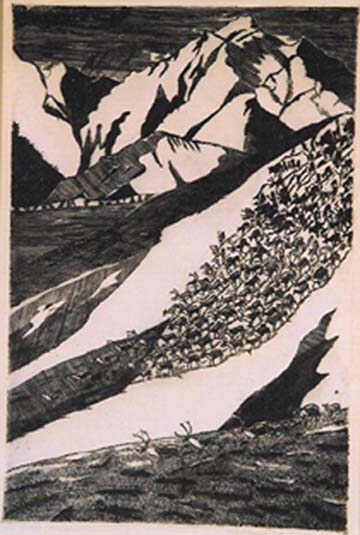
Katexac print titled “tutut” (caribou) print # 7/15, 64, meaning 1964
From the Sweeney collection
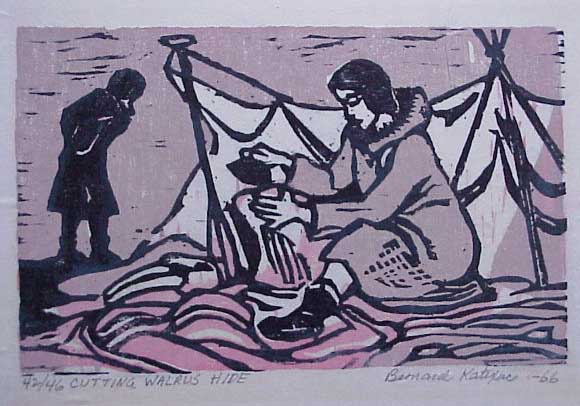
Katexac print titled “Cutting walrus hide”, print # 42/46, 66, meaning 1966
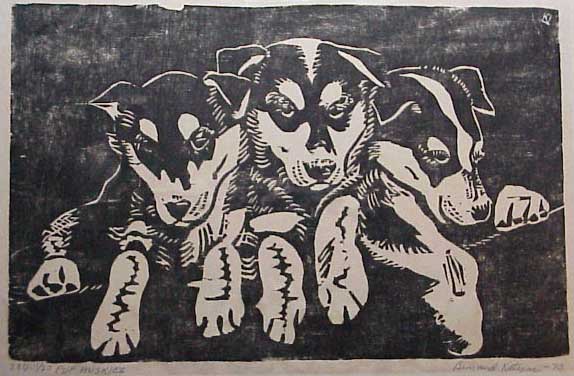
Katexac print titled “Husky pups”, print 2nd ed (second edition) #11/20, 70 meaning 1970
Formerly of the Brent & Kathleen Enterline collection
Sun Prairie, Wi
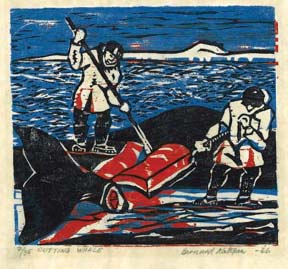
Katexac print titled “Cutting whale hide”, print # 2/35, 66, meaning 1966
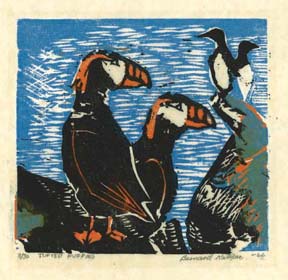
Katexac print titled “Tufted puffins”, print # 3/30, 66, meaning 1966
From the Sweeney collection
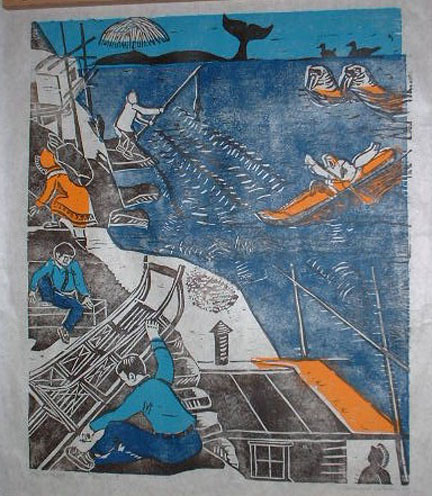
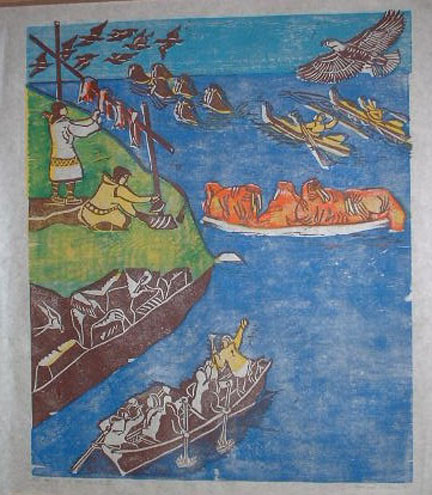
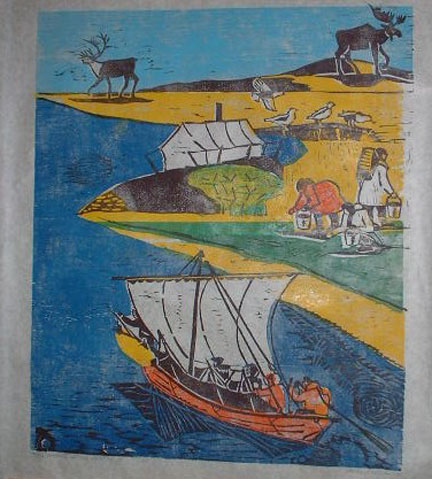
Katexac print titled “Arctic I”, print # 24/30, 77, meaning 1977
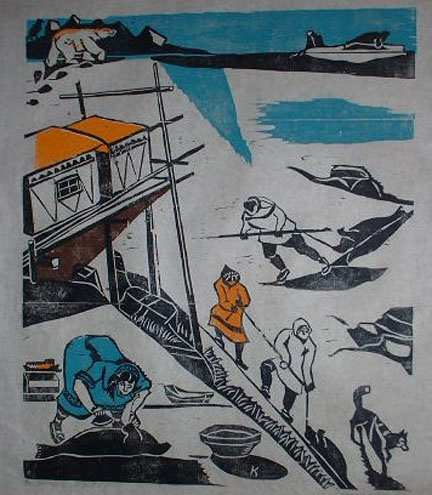
Katexac print titled “Arctic II”, print # 8/30, 77, meaning 1977
Katexac print titled “Arctic III”, print # 12/30, 77, meaning 1977
Katexac print titled “Arctic IV”, print # 12/30, 77, meaning 1977
From the Sweeney collection
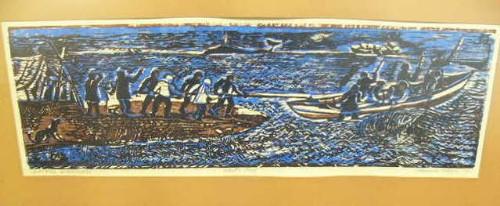
Katexac print titled “Launching Whaleboats”, print artist proof, 70, meaning 1970
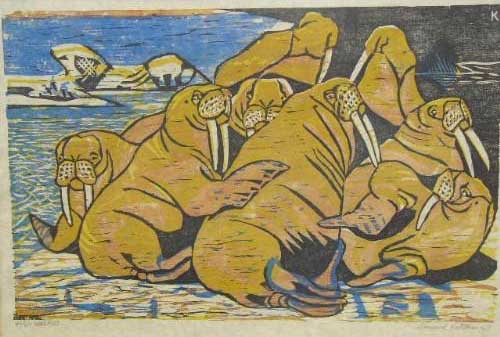
Katexac print titled “Walrus”, 40/40, 69, meaning 1969
A list of Bernard Katexac’s prints by year 1963 to 1977:
Know of a print title that we don’t have listed, please contact us:
“Avik” 1963
“Ezakvalik” translation walrus with baby 1963
“Ukiu vok Miut II” king island village 1963
“Woman skinning seal” 1963
“Akiak” (mother and child) 1964
“Tutut” (caribou) 1964
“Kongit” (reindeer) 1964
“Cliff dwellers” 1965
“Model” 1965
“Tupkit” “wood-skin houses, king island” 1965
“Cutting walrus hide” 1966
“Fishing through ice” 1966
“Kayaker in river” 1966
“Mother and child” 1966
“Nomad’s scrimshaw” 1966
“Rookery” 1966
“Walrus and calf” 1966
“Woman and child” 1966
“Woman skinning seal” 1966
“Shadows in a pond” 1969
“Walrus” 1969
“Launching whaleboats” 1970
“Old ivory etching” 1970
“Pup huskies” 1970
“Girl with a sheefish” 1972
“Walrus on migration” 1972 ( also reproduced as lithograph – 800)
“Saggy movement” 1973
“One chance” 1974
“Mixed eiders” 1975
“Season in the arctic I” 1977
“Season in the arctic II” 1977
“Season in the arctic III” 1977
“Season in the arctic IV” 1977
“Grandmother” 19??